
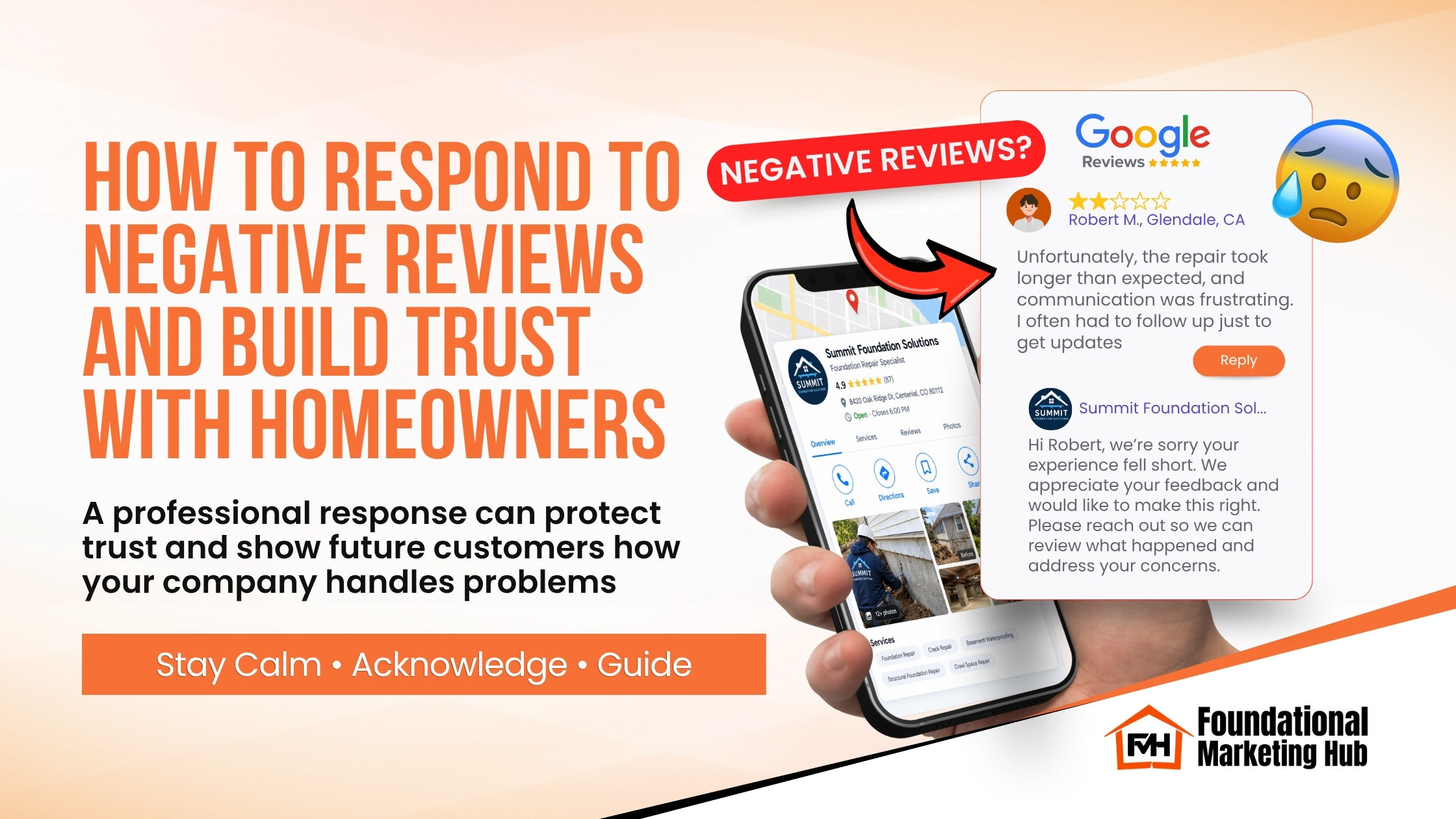
How to Respond to Negative Reviews and Build Trust With Homeowners
How to respond to negative reviews matters more than many foundation repair and basement waterproofing contractors realize. A bad review does not automatically mean a homeowner will choose another company. How you handle the complaint can matter just as much as the review itself.
Homeowners looking for foundation repair or basement waterproofing are often dealing with expensive and stressful problems. Foundation cracks, water intrusion, bowing walls, and damp crawl spaces can make them cautious about who they hire.
Before scheduling an inspection, many homeowners check reviews to answer one question: Can I trust this company with my home?
That makes customer reviews an important part of the decision to call your business and an important part of your overall contractor marketing system.
Why Negative Reviews Matter for Contractors
Foundation repair and basement waterproofing are not small purchases. Homeowners may be worried about repair costs, damage to their property, and whether the problem will get worse.
They may also be comparing several contractors.
Reviews can help them decide whether your company:
A few negative reviews do not automatically ruin your reputation. Ignoring complaints or responding poorly can create a bigger problem.
How to Respond to Negative Reviews Without Making Things Worse
Knowing how to respond to negative reviews starts with staying calm.
Your response is not only for the homeowner who wrote the review. Future customers may read it while deciding whether to call you.
Google also allows verified businesses to publicly read and respond to customer reviews through their Business Profile.
Acknowledge the Concern
You do not have to agree with everything the reviewer says.
Start by showing that you read the complaint.
For example:
“We are sorry to hear that you were disappointed with the communication during your project.”
This is better than immediately trying to prove the homeowner wrong.
Stay Calm and Professional
Avoid turning the review into a public argument.
Do not:
- blame the homeowner
- insult the reviewer
- argue over every detail
- share private information
- write an angry response
Keep the focus on the concern and what happens next.
Give the Homeowner a Next Step
If the issue needs a longer discussion, take the conversation away from the public review.
For example:
“We would like to better understand what happened and see how we can help. Please contact our office so we can review this with you directly.”
This shows future homeowners that your company is willing to address problems.
Use a Simple Four-Step Review Response
Your team does not need to create a completely different response every time.
Use four simple steps:
- Acknowledge the issue.
Show that you read the review. - Stay respectful.
Keep your response calm even when the review is harsh. - Show that you want to help.
Let the homeowner know you are willing to look into the problem. - Move the conversation forward.
Give them a clear way to contact your team.
A response might look like this:
“Thank you for bringing this to our attention. We are sorry the experience did not meet your expectations. We would like to better understand what happened and see how we can help. Please contact our office so we can review this with you directly.”
Short and professional defense is usually better than a long public defense
Contractor Reputation Management Starts Before the Review
Good contractor reputation management is not only about responding after someone complains.
It begins with the homeowner’s experience from the first phone call through the completed project.
Poor reviews can start because:
These may seem like customer service problems, but they can eventually affect how people see your company online.
A stronger follow-up system can also help reduce missed communication after calls, forms, estimates, and completed jobs.
Strong contractor reputation management means improving the experience that creates the reviews in the first place.
Reputation Management for Contractors Means Watching for Patterns
Good reputation management for contractors also means paying attention to repeated complaints.
One complaint about slow communication may be an isolated issue. Several reviews mentioning the same problem should get your attention.
For example, a basement waterproofing company may see several reviews saying customers did not know when they would receive an estimate after their inspection.
The company could improve the process by clearly telling homeowners:
Reviews can help you find problems in the customer experience before they create more complaints.
Respond to Positive Reviews Too
Negative reviews should not be the only ones receiving attention.
When a homeowner takes time to leave a positive review, respond to them too.
Instead of using the same “Thanks for the review” response every time, make it specific.
For a basement waterproofing customer:
“Thank you for trusting our team with your basement waterproofing project. We appreciate you sharing your experience.”
For a foundation repair customer:
“Thank you for the kind words. We are glad our team could help explain the foundation problem and your repair options.”
The response does not need to be long. It should simply sound like a real person wrote it.
Make Review Generation Part of Your Process
Many contractors struggle with review generation because they only ask for reviews when someone remembers.
A better approach is to choose a consistent point in the customer process when review requests should happen.
For example:
Ask customers for honest feedback, rather than only asking customers who have already told you they are happy.
Google says businesses can request genuine reviews, but businesses should not selectively ask only for positive reviews or pressure customers to leave a certain rating. Review Google’s rules for customer reviews.
Build a Simple Review Generation Strategy
A review generation strategy does not need to be complicated.
Your company only needs to decide four things:
| Question | What to Decide |
|---|---|
| Who asks? | Office staff, salesperson, crew leader, or follow-up team |
| When do they ask? | At a consistent point in the customer process |
| How do they ask? | Text, email, or conversation |
| Who checks reviews? | One person responsible for responses |
Assigning responsibility is important.
If everyone is responsible for reviews, they can easily be forgotten.
Choose one person to make sure review requests go out and new reviews receive a response.
Make Leaving a Review Easy
Do not make homeowners search for your company online and figure out where to leave feedback.
Google lets businesses create a direct review link or QR code that can be sent to customers. Create a Google review link or QR code.
Instead of saying:
“Would you mind leaving us a review somewhere online?”
Try:
“Thanks again for trusting us with your project. We would appreciate your honest feedback about your experience. We will send you the review link so it is easy to find.”
Keep the request simple and pressure-free.
Do not offer discounts, gifts, free services, or other rewards in exchange for reviews. Google considers incentivized reviews fake engagement and may remove them or place restrictions on a Business Profile.
What If the Negative Review Seems Unfair?
Some reviews may not match your version of what happened.
The homeowner may misunderstand something or leave out part of the story.
You should still respond professionally.
Avoid trying to win the argument publicly.
A better response is:
“We are sorry to hear that you were unhappy with the experience. We would like to review the project details with you and better understand your concerns. Please contact our office so we can discuss this directly.”
Future homeowners may never know exactly who was right.
They will notice whether your company remained calm and willing to help.
Learn From the Complaint
Posting a response should not be the final step.
If the review points to a real problem, look at what happened.
Ask:
Fixing the reason behind the complaint can help prevent future negative reviews.
Looking at recurring customer concerns alongside your marketing results can also help you understand whether the problem is happening before the call, during the sale, or after the job. FMH’s case studies are one internal resource for seeing how marketing and business results connect.
Common Review Mistakes Contractors Should Avoid
Ignoring negative reviews: An unanswered complaint may make homeowners wonder whether your company cares when something goes wrong.
Writing a long argument: Keep the response focused on acknowledging the concern and finding a solution.
Using the same response every time: Repeated replies can make your business look disconnected from customers.
Only asking for reviews occasionally: Without a regular process, customer feedback may come in inconsistently.
Asking only happy customers: Review requests should be based on a consistent process, not on whether you expect a positive rating.
Ignoring repeated complaints: Similar complaints may point to a larger problem with communication, scheduling, or follow-up.
How Reviews Help Homeowners Decide Who to Call
A homeowner with a foundation crack or wet basement is not only looking for a company that can perform the repair.
They are also wondering:
Will this company explain the problem clearly?
Can I count on them to return my call?
Does the crew show up when promised?
What happens if something goes wrong?
Customer reviews help answer these questions before the homeowner ever speaks to your team.
That is why building a strong reputation is not about looking perfect. It is about showing homeowners that your company communicates, responds, and takes customer concerns seriously.
Reviews can also support the trust homeowners see when your business is visible in Google Search and Google Maps. Getting found matters, but homeowners still need a reason to choose you.
A Simple Weekly Reputation Checklist
Spend a few minutes each week checking:
A simple routine can keep review management from becoming something your team only thinks about after a bad review appears.