Video Marketing for Contractors That Turns Views Into Booked Inspections
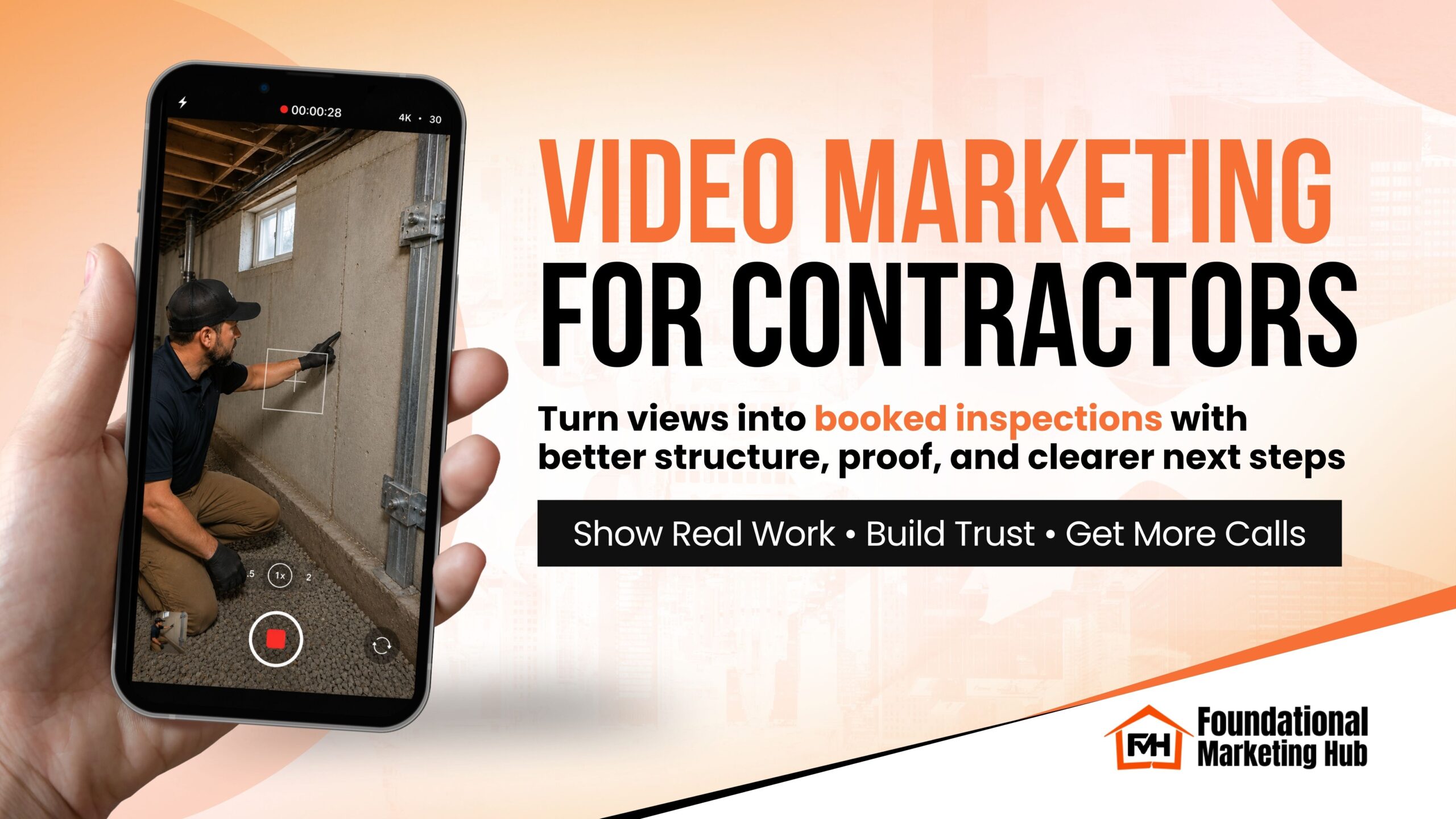
Video marketing for contractors is not about chasing random views. It is about helping the right homeowner see the problem, trust your process, and feel ready to book an inspection.
For foundation repair and basement waterproofing companies, that matters even more. Homeowners are not casually browsing. They are dealing with cracks, basement leaks, crawl space moisture, drainage issues, and expensive problems they do not fully understand yet.
That is why weak videos do not help much. A random job-site clip without context might get watched, but it usually will not build enough trust to turn into a call.
Video marketing for contractors works when each video does one clear job: show proof, explain a real problem, reduce doubt, or make the next step easier. In foundation repair and waterproofing, the goal is not views by themselves. The goal is clearer trust, better homeowner understanding, and more booked inspections.
Why Video Marketing for Contractors Matters More in Foundation Repair and Waterproofing
Homeowners are not just asking who offers the service. They are asking:
A good video can answer all of that faster than a block of text.
A technician explaining why water is getting into a basement wall.
A short crawl space walk-through showing moisture issues.
A before-and-after waterproofing result with simple narration.
A homeowner describing how the inspection process felt clear and low-pressure.
Those are not just content pieces. They are trust signals.
The Real Reason Views Do Not Turn Into Booked Inspections
A lot of companies think a video is working if it gets views.
That is not enough.
Views do not pay for marketing. Booked inspections do.
If a video gets attention but does not help the homeowner understand the issue, trust your team, or know what to do next, then it is not doing enough. The most common reasons that happens are:
In other words, the leak usually is not reach. The leak is conversion.
What Good Video Marketing for Contractors Actually Looks Like
Most weak videos show activity.
Strong videos show understanding.
A high-performing video usually follows this structure:
A single relevant link from a chamber, supplier, or city business page can be more valuable than dozens of low-quality links from unrelated sites.
Useful places to start include the Google Business Profile local ranking guide, the BBB business directory, and the U.S. Chamber chamber directory. These are not magic SEO shortcuts. They are legitimate trust signals that support local visibility.
1. Hook the problem fast
Start with the issue the homeowner actually cares about.
Examples:
The first few seconds should tell the viewer, “This is about a problem like mine.”
2. Show real proof
Use actual job-site footage.
That could be:
This is where trust starts building. It feels real because it is real.
3. Explain what the homeowner is seeing
Do not assume they understand the issue.
Say what is happening in plain English.
For example:
“This water is getting in where pressure is building outside the wall.”
“This crack matters because of the pattern and the movement around it.”
“This crawl space has enough moisture to keep causing problems if it is left alone.”
A homeowner does not need a lecture. They need clarity.
4. Reduce doubt
This is the part a lot of companies skip.
Tell them what the next step usually looks like. Explain what you inspect, what you look for, or how you decide between repair options.
That lowers friction because the homeowner stops guessing what will happen if they reach out.
5. Give one clear next step
Do not overload the ending.
A good next step might be:
The video should make the next move easier, not harder.
Five Video Types That Actually Help Contractors Book More Jobsr for contractors
You do not need dozens of formats. You need a few that consistently build trust.
1. Job-site walk-through videos
These work because they show how your team thinks.
A technician standing in a basement or crawl space explaining why the issue is happening does more than educate. It shows experience, calm, and clarity.
2. Before-and-after videos
These are simple and effective.
Show the problem. Show the fix. Show the result.
This works especially well for:
The key is context. Tell the viewer what changed and why it mattered.
3. Customer testimonial videos
A short, specific testimonial can do what a lot of sales copy cannot.
It reduces fear.
The best testimonial videos are not long. They are concrete. If you want outside examples of how to shape that format, review these testimonial video examples.
4. FAQ videos
These are strong because they meet the homeowner where they are.
Good examples include:
These videos help your company look helpful before the first call.
5. Process videos
A lot of people do not contact a contractor because they still do not know what happens next.
Process videos fix that.
Explain:
That reduces hesitation and helps warmer leads move faster.
How Contractor Video Marketing Builds Trust Before the Call
Strong contractor video marketing is not really about being impressive on camera.
It is about making the company feel easier to trust.
That happens when your content does one of these well:
That is why simple, useful videos usually beat broad brand videos in this niche. The homeowner is not looking for a content creator. They are looking for a company that feels credible.
If you want to build a stronger system behind that content, this is where a smarter social media marketing strategy starts to matter.
A Simple Weekly Video System for Busy Teams
Most companies do not need a huge content machine.
They need a repeatable rhythm.
Here is a practical weekly system:
Monday: film one short job-site explanation
Use one real issue your team saw that week and explain it in plain English.
Wednesday: post one proof-based clip
Use before-and-after footage, a progress clip, or a short customer result story.
Friday: answer one common homeowner question
Pick a question your team hears often and answer it clearly on camera.
That is enough to build consistency without making content feel like another full-time job.
Why Some Owners Search “Video Marketing for Contractors SEO for Contractors”
Some search terms are messy because business owners are trying to solve multiple problems at once.
That is why you may see a phrase like video marketing for contractors seo for contractors. What they usually mean is simple: they want content that helps with visibility and trust at the same time.
That is the real overlap.
Video does not replace local SEO. But it can support the bigger system by:
That is where content stops being filler and starts becoming part of your lead-generation system.
Turn One Good Video Into More Than One Asset
One of the easiest ways to get more mileage out of your content is to stop treating each video like a one-time post.
A single job-site walk-through can become:
If you want a practical outside reference for that process, this guide on how to repurpose your videos is useful.
And if your team is leaning into short-form content more heavily, these YouTube Shorts tips are also worth reviewing.
Common Mistakes That Kill Video Performance
Mistake 1: Talking like a marketer instead of a contractor
If the language sounds broad, polished, or vague, trust drops fast.
Say what is happening. Say why it matters. Say what to do next.
Mistake 2: Showing work without explaining it
A homeowner does not automatically know what they are looking at.
Your video needs context.
Mistake 3: Making every video about your company
The homeowner cares about their wet basement, their crack, their crawl space, and their peace of mind.
Lead with their problem first.
Mistake 4: Leaving out service-area relevance
If you serve specific cities, counties, or neighborhoods, say so when it makes sense.
That makes the content feel more local and more relevant.
Mistake 5: No next step
Every video does not need a hard sell, but it should make the next move easier.
That could mean learning more, seeing proof, or booking a call.
If your company already has job-site footage, customer proof, and real field knowledge but your content still is not turning into booked inspections, the issue is probably not effort.
It is structure.
FMH helps foundation repair and basement waterproofing companies build video and content systems that support trust, visibility, and stronger lead flow. If you want to see what stronger strategy looks like when it is tied to real business outcomes, review these FMH case studies.
And if you want help mapping out the right next step for your market, book a Discovery Call.