
How Can Contractor Digital Marketing Help Your Website Get More Leads?
Contractor digital marketing helps your website get more leads by making your business easier to find, trust, and contact. For foundation repair and basement waterproofing companies, a strong website should clearly explain your services, show proof of your work, and guide homeowners toward calling, filling out a form, or scheduling an inspection.
When your website has clear messaging, simple pages, helpful content, and strong calls to action, it becomes more than an online brochure. It becomes a lead-generating tool that helps turn local visitors into real conversations.
How Does Contractor Digital Marketing Help Your Website?
Contractor digital marketing helps your website attract better visitors, build trust faster, and convert more homeowners into leads. It connects your website, SEO, Google Maps visibility, reviews, content, calls, forms, and follow-up systems so homeowners have a clear path from search to contact.
For foundation repair and basement waterproofing companies, this matters because most homeowners are not casually browsing. They are usually dealing with a real problem like basement water, wall cracks, crawl space moisture, foundation movement, or drainage concerns.
Your website should quickly answer three questions:
When those answers are clear, your website has a much better chance of turning visits into calls, form submissions, and booked inspections.
What Does Contractor Digital Marketing Do for Your Website?
Contractor digital marketing helps your website work as a lead source instead of just a place to list your services. It connects your website, local visibility, reviews, content, paid traffic, and follow-up so homeowners have a clear path from search to contact.
A homeowner may find your business through Google, compare your Google Business Profile, read your reviews, visit your service page, look at your photos, and then decide whether to call.
That means your website cannot work alone. It needs to support the full decision-making process.
A strong contractor digital marketing strategy helps your website:
For foundation repair and waterproofing companies, the goal is not just more website traffic. The goal is more qualified homeowners taking action.
Why Does Website Design for Contractors Matter?
Website design for contractors matters because homeowners often decide quickly whether to stay on a site or leave. If the page is confusing, cluttered, slow, or unclear, visitors may never make it to your contact form.
Good contractor website design starts with a simple message. A homeowner should land on your site and quickly understand who you help, what services you offer, and where you work.
For example, a foundation repair or basement waterproofing website should clearly show if you help with:
Your phone number, contact button, and inspection request form should also be easy to find, especially on mobile. Many homeowners are searching from their phones while dealing with an active issue in their home.
A clean, conversion-focused site helps visitors move from “I have a problem” to “I know who to call.”
If your current site looks outdated, feels hard to use, or does not clearly guide visitors toward action, FMH’s contractor website design services can help turn your website into a stronger lead-generation asset.
What Makes a High-Converting Contractor Website Easier to Use?
A high-converting contractor website is easy to read, easy to move through, and easy to contact from any page. It does not make visitors hunt for answers or guess what to do next.
For contractors, a high-converting website should guide homeowners toward one main action. That may be calling, requesting a quote, or scheduling an inspection.
A strong website often includes:
A high-converting website also keeps the homeowner’s situation in mind. Someone with water in the basement may not want to read a long, confusing page. They want to know if you can help, how quickly they can reach you, and what happens next.
This does not mean your website has to be complicated. It means every page should have a clear purpose.
How Can Contractor Website Design Build Trust?
Contractor website design builds trust by showing homeowners that your company is experienced, local, and able to solve their problem. This is especially important for foundation repair and basement waterproofing companies because homeowners are often worried about cost, damage, and long-term safety.
Strong contractor website design should include proof. Homeowners want signs that other people have trusted your company before them.
Trust-building website elements include:
Your website should also make your business feel approachable. Homeowners do not want vague claims or confusing wording. They want plain answers, real proof, and a simple way to ask for help.
When your website shows real work, real reviews, and clear next steps, visitors are more likely to feel comfortable contacting you.
If reviews are currently weak, inconsistent, or not being used well on your website, FMH’s reputation management services can help support stronger trust signals across your website and local presence.
Why Should You Look at Contractor Website Examples?
Contractor website examples can help you see what makes a website clear, trustworthy, and easy to use. You do not need to copy another contractor’s website, but examples can help you spot what your own site may be missing.
Strong contractor website examples usually have a few things in common. They explain services clearly, show local proof, use strong reviews, and make the next step easy.
When reviewing contractor website examples, look for:
Contractor website examples are especially helpful when planning service pages. For example, a basement waterproofing page should explain common warning signs, possible causes, inspection steps, and when a homeowner should call.
The best contractor website examples are not just nice to look at. They help homeowners understand the problem, trust the company, and take action.
What Website Content Helps Contractors Get More Leads?
Helpful website content gives homeowners answers before they call. When people feel informed, they are more likely to trust your company.
For foundation repair and basement waterproofing businesses, content should focus on real homeowner concerns. Many visitors are not ready to buy the moment they land on your website. They may be trying to understand what is happening in their home.
Helpful content topics may include:
This is where contractor digital marketing supports your website. Instead of only listing services, your content helps answer the questions homeowners are already asking.
Good content can include:
Google’s SEO Starter Guide explains that clear, useful website content helps search engines understand pages and helps users find what they need. Google’s guidance on helpful, reliable, people-first content also reinforces the importance of creating content that genuinely helps people, not just content written to fill a page.
For contractors, that means your content should answer real homeowner questions and connect those answers to a clear next step.
How Do Calls, Forms, and Buttons Turn Visitors Into Leads?
Calls, forms, and buttons help visitors take action when they are ready. If someone wants to contact you, the process should be simple.
A contractor website should use clear calls to action like:
The wording should match what the homeowner wants. For example, “Schedule an Inspection” feels clearer than a button that only says “Submit” or “Learn More.”
Contact forms should also be short. If a form asks too many questions, visitors may leave before finishing it.
A simple form can ask for:
A high-converting website should also include click-to-call buttons for mobile visitors. If someone is standing in their basement looking at water or cracks, they may want to call right away.
Easy contact options are one of the simplest ways to turn more website visitors into leads.
How Can Local Visibility Support Your Website?
Local visibility helps nearby homeowners find your website when they search for services in their area. For contractors, this is important because most customers want a local company they can trust.
A foundation repair or basement waterproofing contractor does not need random visitors from outside the service area. The goal is to attract local homeowners who need help and are likely to become real leads.
Local visibility can be supported by:
Google’s local ranking guidance explains that local results are influenced by relevance, distance, and prominence. For contractors, that means your website, Google Business Profile, reviews, and local content all need to support the areas and services you want to be found for.
This is where contractor SEO matters. Strong SEO for foundation repair and waterproofing companies helps connect your website, service pages, Google Maps visibility, and local search strategy so homeowners can find you when they are ready to call.
Weak Contractor Website vs. Lead-Focused Contractor Website
| Website Area | Weak Contractor Website | Lead-Focused Contractor Website |
|---|---|---|
| Homepage message | Vague or confusing | Clear about services and service area |
| Contact options | Hard to find | Phone number and forms are easy to use |
| Trust proof | Few reviews or photos | Reviews, photos, and project proof are visible |
| Service pages | Thin or unclear | Helpful, specific, and easy to understand |
| Mobile experience | Hard to use on phones | Easy to call or request help |
| Content | Little helpful information | Answers real homeowner questions |
| Calls to action | Generic buttons | Clear next steps like “Schedule an Inspection |
| Follow-up | Manual or inconsistent | Calls, forms, SMS, and email are connected |
What Mistakes Stop Contractor Websites From Getting Leads?
Contractor websites often lose leads when the message is unclear, the pages are hard to use, or contact options are difficult to find. Even a good-looking website can fail if it does not guide visitors toward action.
Common mistakes include:
Another common mistake is talking too much about the company and not enough about the homeowner’s problem. Visitors want to know if you can help, what happens next, and why they should trust you.
Strong contractor website design should focus on the visitor’s needs. It should make the next step easy and remove confusion wherever possible.
If your website gets traffic but does not bring in enough calls or form submissions, the issue may not be the number of visitors. The issue may be that your site is not helping those visitors feel ready to act.
Why Follow-Up Matters After Someone Contacts Your Website
Getting the lead is only the first step. If a homeowner fills out a form, calls, or sends a message, your response time matters.
Many contractors lose leads after the website does its job because the follow-up process is too slow or too manual. A homeowner who is dealing with water in the basement or visible foundation movement may contact more than one company. If your team waits too long, that lead may book with someone else.
That is why website lead generation should connect to follow-up systems.
Strong follow-up may include:
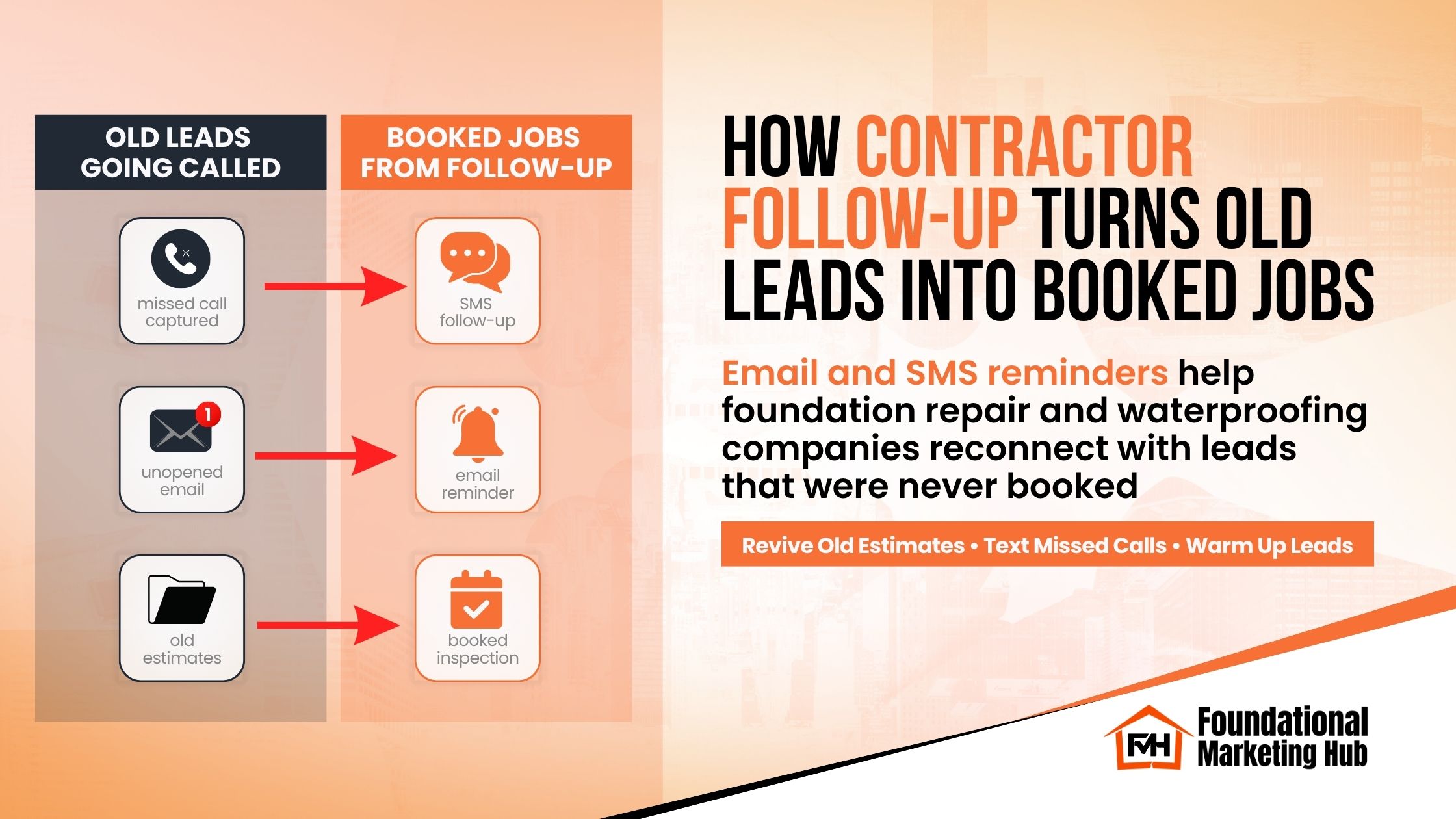
FMH’s email and SMS automation services help contractors respond faster, organize leads, and reduce the number of opportunities that go cold after someone reaches out.
A better website brings in the lead. A better follow-up system helps turn that lead into a booked inspection.
How Can Your Website Turn More Visitors Into Leads?
Your website should help homeowners understand their problem, trust your company, and take the next step with confidence. That is where contractor digital marketing can make a real difference.
Clear messaging, simple navigation, real proof, helpful content, strong local visibility, and easy contact options all work together to help more visitors become leads.
If your website is getting visitors but not enough calls, it may be time to improve how well it guides homeowners toward action.
Want a contractor website that helps bring in more leads? Schedule a Discovery Call with Foundational Marketing Hub to see how we can help improve your website, local visibility, and lead flow.